
valeria.rodriguez@lawrank.com | June 1, 2022 | Truck Accidents
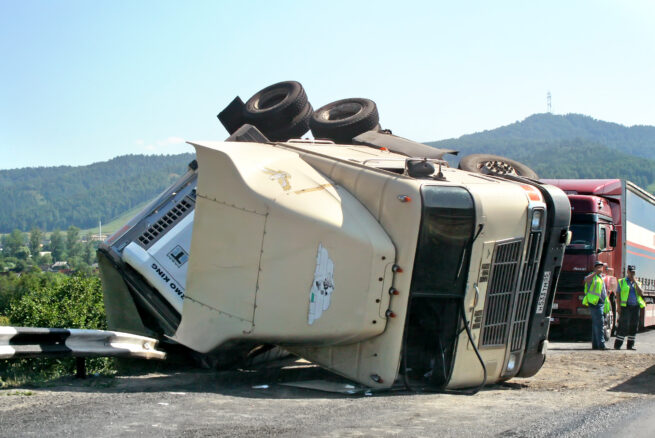
It can be intimidating to see a large 18-wheeler fly by while traveling along Houston roadways. Speed limits are designated to protect everyone on the road and are set to be the maximum under the best weather and road conditions. When conditions are bad, the law stipulates that vehicles should travel at slower, safer speeds.
Semi-trucks need to be even more cautious about poor visibility, weather, or road conditions. These vehicles can weigh 20-30 times as much as passenger cars and have a higher center of gravity, making them unstable.
Passenger car drivers should learn how to drive defensively around these trucks, while commercial truck drivers should be aware of the speed limits and other rules in every state and municipality.
What Are the Legal Speed Limits in Texas?
The maximum speed limit on most Texas highways is 70 mph, although parts of I-10 and I-20 have higher speed limits — either 75 mph or 80 mph — running through ten counties in the western part of the state. Semis are responsible for following posted speed limits on all roads.
Different roadways have different speed limits. For example, business and residential districts typically have speed limits between 30 and 35 mph, but other two- and four-lane highways may have speed limits between 45 and 55 mph.
When Should Tractor-Trailers Slow Down?
The Federal Motor Carrier Safety Administration (FMCSA) advises truckers to adjust their speeds depending on weather, visibility, traffic, and general road conditions. For example, truckers should reduce their speeds on wet or snowy roads by about one-third of the posted speed limits.
However, traveling too slow, especially under normal road conditions, also carries some danger. For example, the gradient of some roads may require vehicles to maintain a certain speed to avoid drifting or have enough momentum to reach the peak of a hill.
Some other things for commercial vehicle operators to consider about their speed are:
- Traffic conditions, construction zones, and detours
- Conditions where visibility is low, such as night, rain, or fog
- Road hazards, like debris, or poor conditions, such as uneven or gravel roads
- Intersections and roadway merging zones
- Curves, bends in the road, and sharp turns
- Hills and inclines
Drivers should also take care when making deliveries near city centers or other high-population areas with a higher percentage of pedestrians and bicyclists.
Facts About High-Speed Truck Crashes
Commercial trucking speed plays a significant factor in collisions.
The FMCSA notes the following statistics:
- 23% of large truck collisions happen when commercial drivers are traveling too fast
- 25% of speeding-related truck wreck fatalities occur in poor weather conditions
- 40% of semi-truck collision fatalities occur on curves in the road
- 20-30% of commercial truck collisions happen near highway ramps
- Semis with fully loaded trailers are ten times more likely to roll when traveling at high speeds than those with empty trailers
As a passenger car driver, knowing when and how truck collisions usually occur — especially those with catastrophic consequences — can help you drive defensively and take evasive precautions if you notice something amiss.
Why Do Speed-Related Commercial Trucking Accidents Occur?
Larger size, higher center of gravity, greater inertia, and extensive length make semi-trucks more susceptible to speed-related collisions than other vehicles.
Drivers who don’t account for the vulnerabilities of their trucks can put everyone in danger.
Traveling at unsafe speeds can lead to the following kinds of commercial truck accidents:
- Rollovers
- Jackknifing
- Tire blowouts
- Pedestrian accidents
- Stop-short collisions
- Skidding out and losing control of the vehicle
- Sideswipe or swaying collisions
- Rear-ending accidents
Even if the accident only involves the trucker, they can be seriously hurt. Additionally, the truck wreck can impede traffic, leading to other vehicles colliding as they try to avoid the wrecked truck and other debris.
Semi-trailers can be dangerous, but understanding where the dangers lie can help other drivers stay safe.
Contact the Houston Truck Accident Lawyers at Attorney Brian White Personal Injury Lawyers For Help
Contact the Houston personal injury law firm of Attorney Brian White Personal Injury Lawyers at (713) 500-5000.
Attorney Brian White Personal Injury Lawyers – Houston, TX
3120 Southwest Freeway, Suite 350, Houston, TX 77098
Attorney Brian White Personal Injury Lawyers – East Fwy, Houston, TX
11811 East Fwy, Suite 630-06, Houston, TX 77029
Attorney Brian White Personal Injury Lawyers – South Loop, Houston, TX
2600 S Loop W, Suite 293, Houston, TX 77054
Attorney Brian White Personal Injury Lawyers – Katy Freeway, Houston, TX
11511 Katy Fwy Suite 515, Houston, TX 77079
Attorney Brian White Personal Injury Lawyers – Clear Lake, Houston, TX
1300 Bay Area Blvd Suite B268, Houston, TX 77058
Attorney Brian White Personal Injury Lawyers – Cypress, TX
4606 Farm to Market 1960 Rd W, Ste. 444, Houston, TX 77069
Attorney Brian White Personal Injury Lawyers – The Woodlands, TX
1776 Woodstead Ct ste 203, The Woodlands, TX 77380
About the Author Brian White

Brian White earned his J.D. from South Texas College of Law in Houston and is licensed to practice in Texas. He is a Board-Certified Personal Injury Trial Lawyer.
Dedicated to giving back, he actively supports local charities and community initiatives.
Client testimonials highlight Brian’s compassion, open communication, and dedication to achieving the best outcomes for those he represents.
Avvo / Justia / Linkedin / Facebook / Youtube / Instagram / Yelp /